Blog
Pulveriser Setup for Consistent Laboratory Results Under Increasing Throughput Pressure


Pulveriser setup for consistent laboratory results becomes critical as soon as sample volumes begin to increase in a mining laboratory.
Mining laboratories rarely experience sudden analytical failure. What they experience instead is a gradual loss of confidence in results as throughput increases*.
At lower volumes, sample preparation practices tend to hold steady. As demand rises, those same practices (crushing, splitting, and pulverising) begin to compress under pressure.
Sample preparation is pushed harder, small shortcuts appear, and variability starts to creep in unnoticed.
Repeats increase. QA flags become more frequent. Results can begin to drift though the analytical method, instrumentation, and team have not changed. This must be confirmed through rigorous QA/QC checks.
In most cases, the issue is not analytical performance. It is how consistently the sample is prepared before it ever reaches the instrument.
Why Do Laboratory Results Drift as Sample Volumes Increase?
Result drift rarely appears as a single failure point. It develops gradually as pressure increases across the system.
As throughput rises, once-stable sample preparation practices begin to slip, or get rushed and cut short. Bowls are cleaned slightly less thoroughly. Grinding media wear accumulates unnoticed. Sample handling becomes faster, but less controlled. Cooling delays between runs start to appear, a sign the pulveriser is being pushed beyond its capacity. Each change is small. Together, they alter the conditions that determine grind consistency and sample quality.
This is why laboratories often experience drift without identifying a clear cause. The method has not changed, but the preparation environment has.
In high-throughput analytical laboratories, repeats are often the first measurable signal that results are starting to drift.
QA Drift in High-Throughput Analytical Laboratory Environments
When QA result drift appears, the first response is usually to look at the analytical side. Instruments are recalibrated. Reagents are reviewed. Operators are questioned.
However, many QA investigations overlook a more fundamental point.
If the sample preparation stage has changed under throughput pressure, adjustments made at the analytical instrument cannot fix at the analytical testing what was already lost during sample preparation.
Drift in results is often the cumulative result of upstream variability that no single operator can easily see in isolation.
This is where ELS positions pulverising correctly, not as a background step, but as part of the QA system itself.
Pulverising Is a Repeatability Discipline, not a Milling Step.
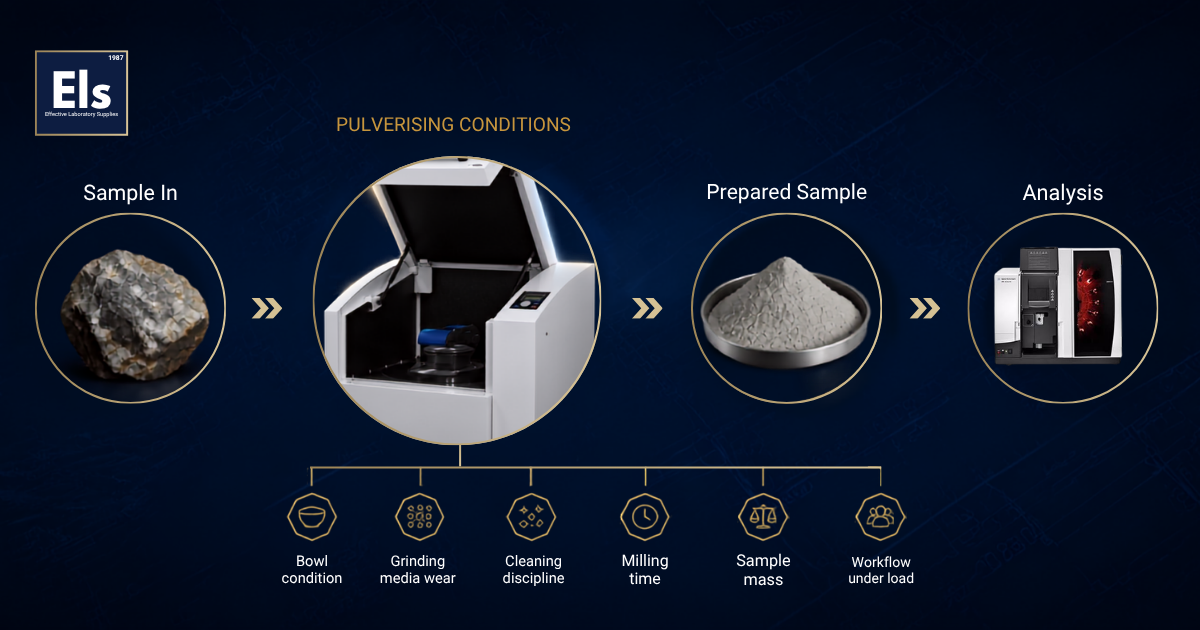
Pulverising is often treated as a mechanical reduction process. In practice, it is a discipline of repeatability.
If the same sample does not produce the same result under the same conditions, the system is not controlled.
Repeatability is affected by variables at every stage, but it is most often lost at the sample preparation step, long before the sample reaches the instrument.
In sample preparation, this includes bowl condition, grind consistency, cleaning discipline, and operator workflow under load.
Milling Bowl Selection for Mining Laboratory Performance
Correct bowl selection directly affects grind consistency, operator safety, and throughput stability.
Smaller ring and puck systems are typically used for standard pulverising applications where the sample mass is lower. Larger operations move toward grinding disc systems designed for higher mass and throughput.
Equipment selection is not only about capacity. It is also about operator capability, workflow design, and sample consistency under load.
ELS supports laboratories with a full range of solutions, including swing mills, spindle systems, and high-capacity platforms, such as the six pot swing mill, for higher-volume applications.
For laboratories using multi-pot configurations or disc-based systems, vibratory platforms, such as vibratory disc mills, introduce additional workflow considerations that must be managed as part of the overall setup. For example, cleaning sequences across multiple pots or managing sample sequencing to avoid cross-contamination.
Grinding Media Wear and Analytical Accuracy
Grinding media wear is often treated as a cost consideration. In practice, it is a data quality variable.
As bowls wear, internal geometry changes. Grinding efficiency shifts. Particle size distribution becomes less consistent.
For acid digestion work, laboratories typically target 80 to 85 percent passing 75 microns during pulverising. XRF applications may require a passing rate closer to 95 percent for material that passes through a 75-micron screen. If the bowl is worn and the grind is too coarse, the sample won’t achieve these targets. Worse still, by the time the sample reaches the instrument, it is too far gone to fix.
Consistency is lost; sampling bias is introduced before analysis begins. That bias cannot be corrected downstream.
Wear management is therefore not maintenance. It is quality control.
How to Monitor Pulveriser Performance in a Mining Lab
Most laboratories operate using lag indicators (measures that only tell you something went wrong in retrospect). These include failed CRMs, QA flags, and repeats.
ELS focuses on lead measures that show system drift before results fail.
These include:
- Monthly bowl weighing to track wear trends.
- Controlled grind performance testing using a fixed sample.
- 75-micron pass-rate tracking over time.
- CRM and blank insertion for contamination and swapping detection.
- Bowl rotation strategies to stabilise output.
- Colour-coded systems for traceability in high-throughput environments.
“These would be lead measures, instead of waiting for bad results, and now you have to figure out what’s going on,” notes Gareth.
Lead measures allow laboratories to correct drift before it becomes a reporting issue.
Why Adding Staff Does Not Solve Throughput Constraints
When throughput increases, it is often assumed that additional staff will resolve pressure.
However, a pulveriser has a fixed processing capacity based on its design and configuration.
If the equipment is already operating at or near capacity, additional operators do not increase output. They only redistribute the workload.
The constraint is therefore not labour. It is system capacity.
ELS helps laboratories identify where the actual bottleneck sits, whether in equipment selection, workflow design, or preparation configuration.
Equipment and Setup Consultation
ELS provides equipment and setup consultation services focused on identifying the true constraint to laboratory throughput.
Rather than adding unnecessary equipment or labour, the aim is to determine the minimum configuration change needed to restore control, consistency, and confidence.
This includes review of pulveriser selection, milling bowls, grinding media performance, and overall workflow design.
Consistent Results Start Upstream
When laboratory results begin to drift, the most visible systems are often not the source of the problem.
Analytical instruments reflect the condition of the sample they receive.
If sample preparation is unstable, results will be unstable.
ELS offers a complete range of pulverising systems and sample preparation equipment, supported by practical experience in high-throughput mining environments.
If your laboratory is experiencing increasing repeats, QA uncertainty, or throughput pressure, the preparation system should be reviewed before drift becomes the baseline.
Protect Analytical Confidence at the Preparation Stage
Experiencing increasing repeats, QA uncertainty, or throughput pressure?